Our experienced technical team has helped companies assess thousands of structures for integrity and performance. When applied correctly, FEA provides many benefits over hand calculations and prototype testing for productivity and innovation.
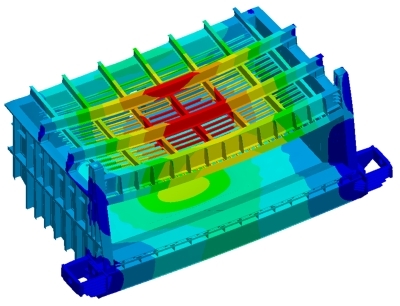
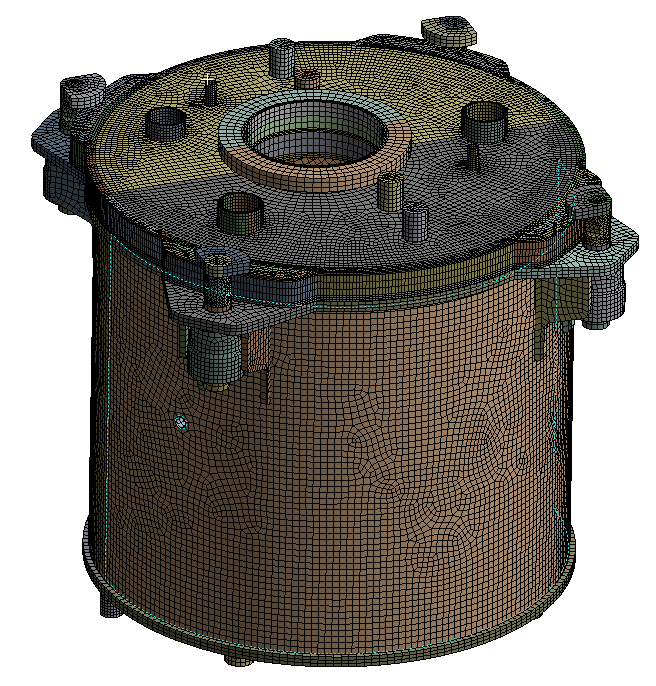
Successful stress, deflection and thermal simulations require models to be set up and interpreted correctly, including quality meshing and realistic assembly contact. Our breadth of software capabilities and in-house expertise enable us to choose the right analysis approach to match the application, covering beam, shell and solid meshing, contact modelling and handling of static and dynamic loading conditions. In many cases, these models have to adhere to the requirements of regulatory standards and codes.
We regularly undertake design assessments regarding compliance with regulatory standards and codes, including all types of static, dynamic and buckling simulations for fabrication and assemblies. We also perform the bespoke assessment of designs not in-line with conventional codes and standards.
We have a large consulting team for structural analysis project work and to help our clients expand their FEA capacity and skills at short notice.
Stress
Thermal
Pressure
Dynamics
Buckling
Fatigue
Materials
Structural analysis projects typically include the identification and risk assessment of failure modes. Common failure modes are mechanical overloading, plastic collapse, localised yielding or wear. We are familiar with assessing structures to various design codes such as ASME VIII Div. 2, BS EN ISO 3449:2008., DEF STAN 08-123, BR 3021, MIL-STD-810, RTCA DO-160 and DN-RP-F112.
However, we have also investigated other potential causes of failure such as hydrogen embrittlement and ageing, including stress corrosion cracking of stainless steel subsea equipment to DN-RP-F112.
We can predict progressive failure using advanced fracture mechanics capabilities, including application of the Paris Law for aluminium structures.
Often structural stress is caused by temperature gradients. Both steady-state and transient thermal analysis have been undertaken using Ansys and other FEA codes.
We have simulated thermal cracking of ceramic refractory tiles due to quenching processes, in addition to thermo-mechanical simulations for a diverse range of products including engine ice protection systems, ceramic catalysts, oil well plug systems and roof tiles. Results have been validated through physical test data and thermal shock tests.
Our structural analysis and fluid dynamics capabilities can be combined to study fluid-structure interaction (FSI) behaviour, including both thermal and pressure loading.
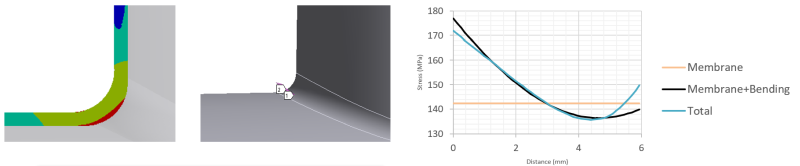
We regularly undertake design assessment for code compliance. We are very familiar with PD5500, Eurocode and ASME VIII & ASME V Design by Analysis for pressure vessel and related equipment, including stress linearisation. We also undertake the bespoke assessment of designs not in-line with conventional codes and standards.
Courtesy: Baker Perkins
We also run a popular software-neutral Design By Analysistraining course to help engineers meet the requirements of ASME VIII Div. 2 using Finite Element Analysis (FEA).
Stress Linearisation
We support both implicit and explicit dynamic analysis with Ansys Mechanical and Ansys LS-DYNA, in addition to kinematic (rigid body) simulations to extract dynamic loads from reciprocating machinery. Natural frequency (modal), harmonic, response spectrum and random vibration applications are common to understand how a system performs relative to its critical frequencies.
Projects range from automotive after treatment systems, fuel oil coolers, nuclear gloveboxes to gas holders. Sources of dynamic loads vary widely, from gas pulsations within internal baffles and rotating equipment to road vibrations and seismic events.
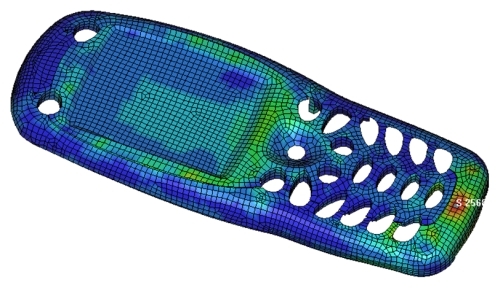
Through our long-term relationship with the off-road vehicle industry, we are highly experienced in transient dynamic analysis such as the assessment of falling object protective structures (FOPS) to BS EN ISO 3449:2008. Impact or blast simulations have included mobile phone drop tests to regulatory requirements and explosion-resistant safety enclosures for ATEX certification, together with shock testing for marine applications to recognised standards such as BV 0430.
Historical Drop Test Analysis
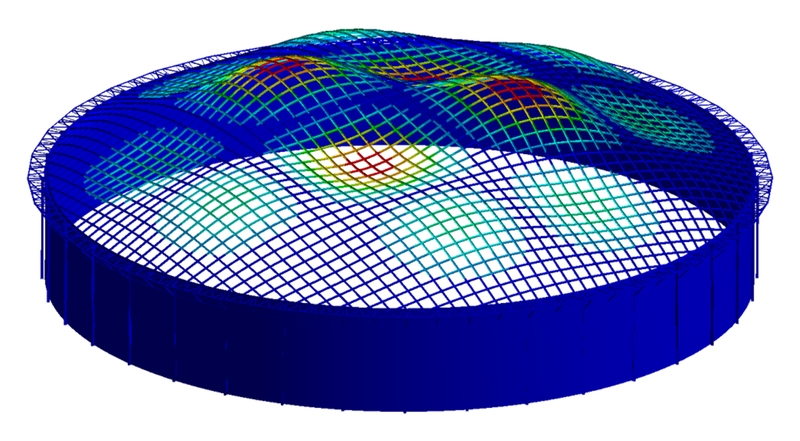
A major consideration for many load-bearing structures, we predict buckling-capacity safety-factors using both linear and non-linear approaches. Some examples of recent projects include offshore fabricated towers, railway masts, bridges and outdoor storage tanks subject to variable wind loading.
Fatigue life prediction of structures and systems has been one of our most common applications over three decades, correlating results with physical test data where it is available. Whether the excitations are static or dynamic, regular or completely random, we ensure designs meet their requirements for safe-life or damage-tolerant design.
We have experience in fatigue life predictions within many industries, from mixing vessels and ship-based rotating equipment to speciality bridges subject to multiple crossings, applying relevant codes such as Eurocode, PD5500 and DNV CN30-7.
Gearbox fatigue assessment – operating points in relation to fatigue limit
In addition to ‘linear’ metallic materials, we are also very familiar with hyperelastic and creep modelling of polymers and rubbers for seals, housings and other products.
We can translate complex non-linear behaviour into efficient material models suitable for FEA. This includes the project management of material physical tests and development & validation of constitutive models to implement within our clients’ analysis software.
We have significant experience handling large deformation problems involving extensive contact and rigid body motion, covering nuclear, aerospace, automotive, electronic and consumer products among other industries. Some of these applications exploit our complementary capabilities to model metal forming processes.
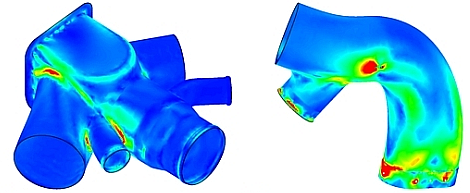
With specialised skills in the analysis of GRP, sandwich, honeycomb and other anisotropic composite materials, we have undertaken a range of projects in aerospace and other industries requiring strong, lightweight structures.
Our structural polymer capabilities are also supported by our injection moulding simulation experience.
Composite Ducting Analysis
Our Experience
There is no substitute for experience. We have been helping companies through our simulation consulting services since 1980, when the technology was still emerging and immature.
Delivered by our large inhouse team of Chartered Engineers, Metallurgists and Physicists, we have undertaken in excess of 5,000 projects for start-ups, SMEs and multinational engineering companies.
Image Courtesy: Forum Energy Technologies & Helix Canyon Offshore
We can offer you much more than a simple yes/no on whether your design, process or strategy is working well. Through our team of Chartered Engineers, we can generate insight, fresh ideas and potential solutions through experience, engineering knowledge, advanced analysis technologies and evolving optimisation methodologies.
This ranges from design guidance on machined & welded structures and support when developing products with 3D printing and other advanced manufacturing processes, through to specialist expertise on sealing & tribology and mentoring on design-for-reliability improvement programmes.
This has been a very productive and informative piece of work from my point of view. It has shed some very encouraging light on the expected behaviour of the larger scale devices and I am very optimistic about the future of the concept. Thank you for managing to combine competence with charm, it’s been a pleasure. I do indeed hope to work with Wilde again in the future.
Oleotec
….thank you again for all your hard work with our project. We are very satisfied with the work produced and I am pleased that we have furthered our understanding of our product. I believe this is an important step in advancing our technical information and I look forward to working with you again in the future.
Gantry Rail
The consultancy project enabled us to spot errors that would have cost much more than the sum of the analysis itself. It enabled us to see things before we committed to them which is very beneficial, especially in terms of the high financial investment involved in the design of the larger components. It made sense to us to analyse these high value components, as the cost of modifying the tooling is so high.
Dudley Industries
I would just like to thank everyone at Wilde for the high quality FEA work on some new products we are bringing to market. Without doubt, the analysis helped us design a product that will outperform our original design. The engineers involved were most helpful, not only in delivering the work but also explaining the results and working with us on design improvements. I will certainly be using the service on future products we bring to market.
Flambeau
For us, the advantage of using Wilde’s consultancy services is that we can give our client confidence in the results that we present to them.
Precision Moulds & Tools Services
We were very impressed with how well the process went. Compared to our previous experience of product development / FEA with a prior company, we felt that the process with Wilde was much faster, with results expertly presented and proven to be accurate.
Mergon International
The project fully met our defined objectives and gave us exactly what we wanted. I was particularly impressed with the Wilde engineer’s knowledge of materials – not many mechanical engineers would know so much about stress properties but he was very clued up on this. In terms of value for money, I would give Wilde ten out of ten
Pipeline Engineering & Supply Co.
It was very useful to us to get a feeling for how the seal behaves from before fixing to fixed. We would certainly include this phase for future jobs where we plan to use straight tooling for manufacture.
Crux Products
Wilde have given a first-rate service enabling us to prove and improve critical design features.
Moffat 2000
We’d like to thank you for your help with this project. Getting such concise and helpful information back will ultimately help in our quest to buy the ANSYS software.
Victor Lighting
Wilde provided efficient communication with a cost effective approach within the timescale required to keep the project on target. The final report was delivered to both our client and Lloyds Register for third party approval. The team at Wilde gave excellent back up after the report had been delivered, answering any queries relating to the analysis that was raised by the third party body.
Contitech Oil & Gas
Wilde quickly understood the analysis that needed to be done on the Forward Tooling Assembly and used their FEA and CFD expertise to develop a new design to optimise the efficiency of the new vehicle within the required time scales.
Forum Energy Technologies
Wilde Analysis supply MMD with all our ANSYS products, along with providing technical assistance on some of our more challenging consultancy projects. Their depth of knowledge and wealth of experience along with the support of the very latest analysis software have been contributory factors in helping MMD to stay at the forefront of mining machinery design.
MMD Design and Consultancy
The job was delivered on time with a very proactive approach from their engineers. Subsequent tests on the machine have proven the model to be accurate and allowed the design to develop.
Edwards Vacuum
Wilde Analysis Ltd are a very professional and competent organisation and employees.
JCB Landpower
Everything about Wilde exuded first class quality from the moment [they] came to visit us to listen to our requirements. Then using Wilde’s extensive experience to provide Darchem with advice on the most cost and time effective options available for the analysis, whilst retaining accurate and robust results. The end report, results and the time scale in which this was achieved, further confirmed Wilde’s quality of service.
Esterline (Darchem Engineering)
... a key project that we had originally planned to do in-house, but our internal resources were pushed to the limit... passed it on to Wilde to complete at very short notice. They responded immediately & completed everything very quickly... They pulled it out of the bag very impressively & were the perfect solution to our difficulty. Added to that, Wilde provided excellent value for money compared to other companies that we have considered in the past.
Chesterfield Special Cylinders
Wilde’s ANSYS consultancy services had been recommended to us by another company. This was therefore the first time that we had used them and we were very satisfied with their work for us. They enabled us to meet our main objective, which was to provide independent clarification on our own calculations. Everything was done to the agreed timescale, and we were very happy with the level of communication.
Dodd Engineering
We gained a lot from our visit and are in the process of putting it into action here at CPI. We hope and feel sure there will be future scope to work with you again on other projects that the company will be involved with and will look to contact Wilde as and when those projects arrive.
Compressor Products International Ltd
Wilde’s consultancy work has answered many of our questions and cut down significantly on our testing time – fewer iterations mean less costs to us which has to be beneficial.
RMI Pressure Systems
It was a case of us needing to get the job done quickly. Like many other companies, we don’t always have the skills and labour resources available to us in house, as our work flow varies.... If you have a good supplier, they become an extension of your business, in whom you can have confidence and rely upon when needed. This is where Wilde proves so useful to us; their engineers are really helpful, highly knowledgeable and very competent.
Baker Perkins
Wilde quickly understood the scope of the analysis & defined precisely the engineering information that would be required....... The product design was modified on the basis of the analysis. Samples subsequently passed rigorous environmental testing including vibration & drop testing before the design was released for high volume production.…pleased with the time Wilde take to understand our requirements …used them on a number of projects.
Plextek
... Willerby has worked closely with Wilde Analysis on new product development. The work has included in depth FEA and part optimisation studies relating to new product developments.... The work has resulted in excellent opportunities to reduce component part count and material content. Due to the success of this partnership, it is highly likely that further studies will be conducted between the two organisations going forward.
Willerby Holiday Homes
We are very happy with the service that Wilde provided. Their consultancy work for us offered us peace of mind that investment on our part in tooling is worthwhile and meets the functional brief.
Edincare Pumped Drainage Systems
We always appreciate Wilde’s approach as working with them is very beneficial for us, both in terms of project costs & knowledge transfer. They are very open about the results, barriers & difficulties involved, & do their utmost to make sure the models are validated, which not many other companies would do. Wilde go to great lengths to produce the accurate results we need, that’s why we have developed a successful working relationship.
Eminox
The particular assembly that was evaluated is fitted into what we would consider to be a severe application. The study based on the FE analysis results demonstrated that there were no areas that are significantly highly stressed which in turn gives confidence with similar designs fitted to less demanding applications. The study that Wilde performed for us gives us confidence to look for similar type of assistance in the future.
Helical Technology
Wilde Analysis achieved everything that we asked of them, within the required timescale. The results were presented exactly as requested and we’re very pleased with the outcome.
Ilmor Engineering
I in particular found the briefing informative and your report was excellent in terms of depth, analysis and presentation.
With an experienced and highly qualified technical team, we can undertake projects on your behalf while maintaining close contact with your in-house operations regarding progress and technical issues. Our flexible project options enable you to control your budgets and avoid the risk of overspend while assured of a timely, reliable and quality solution.
Flexibility
Flexibility is key to our services.
We run projects as short a half a day for a straightforward verification exercise to multi-year contracts to support and optimise new product development.
Most standard project work is undertaken within our head office in the UK for efficiency but this can be combined with on-site Secondments and Technology Transfer services.
Communication
Close communication ensures we deliver to your requirements.
You are allocated an account manager who works alongside our consulting staff to ensure both your commercial and technical objectives are met.
The scope of any project is clearly agreed and defined upfront and we ensure that you are kept informed of progress. This includes any discoveries, issues or concerns that arise from intermediate results that may influence the direction and duration of the project.
Project meetings are important and encouraged, particularly for complex assignments or design optimisation services. These can take place either at our headquarters or your offices. In addition, to minimise your project costs and delivery times while adhering to our Environmental Management policy, we promote web conferencing as much as possible.
Reporting
Clear and meaningful presentation of results is an essential way for us to add value. Various levels of reporting are available to suit your requirements
Extensive – often required for regulatory authorities
Standard – Full report, but without the detail of the Extensive report
Summary – Limited to basic facts and important conclusions, often presented in a slide format
If you would like to continue the project in-house, we can also deliver the results databases from any analysis tools used to enable you to recreate the analysis and further investigate the results. This can include the provision of appropriate software licenses.
Pricing
After agreeing a scope of work and timescales, we can structure the pricing of your project in many ways
Fixed Price, against fixed quotation.
Reimbursable.
Reimbursable, against target price.
Call-off contracts
How Can We Help?
For more information or to arrange an informal, no-obligation discussion on your requirements, please complete the form opposite or contact us using the details below.
From an initial phone call we can often give you an idea of price and time scales.
With subsequent details, we can then send you some solution ideas, scopes of work and a formal quotation.



This has been a very productive and informative piece of work from my point of view. It has shed some very encouraging light on the expected behaviour of the larger scale devices and I am very optimistic about the future of the concept. Thank you for managing to combine competence with charm, it’s been a pleasure. I do indeed hope to work with Wilde again in the future.
Oleotec
….thank you again for all your hard work with our project. We are very satisfied with the work produced and I am pleased that we have furthered our understanding of our product. I believe this is an important step in advancing our technical information and I look forward to working with you again in the future.
Gantry Rail
The consultancy project enabled us to spot errors that would have cost much more than the sum of the analysis itself. It enabled us to see things before we committed to them which is very beneficial, especially in terms of the high financial investment involved in the design of the larger components. It made sense to us to analyse these high value components, as the cost of modifying the tooling is so high.
Dudley Industries
I would just like to thank everyone at Wilde for the high quality FEA work on some new products we are bringing to market. Without doubt, the analysis helped us design a product that will outperform our original design. The engineers involved were most helpful, not only in delivering the work but also explaining the results and working with us on design improvements. I will certainly be using the service on future products we bring to market.
Flambeau
For us, the advantage of using Wilde’s consultancy services is that we can give our client confidence in the results that we present to them.
Precision Moulds & Tools Services
We were very impressed with how well the process went. Compared to our previous experience of product development / FEA with a prior company, we felt that the process with Wilde was much faster, with results expertly presented and proven to be accurate.
Mergon International
The project fully met our defined objectives and gave us exactly what we wanted. I was particularly impressed with the Wilde engineer’s knowledge of materials – not many mechanical engineers would know so much about stress properties but he was very clued up on this. In terms of value for money, I would give Wilde ten out of ten
Pipeline Engineering & Supply Co.
It was very useful to us to get a feeling for how the seal behaves from before fixing to fixed. We would certainly include this phase for future jobs where we plan to use straight tooling for manufacture.
Crux Products
Wilde have given a first-rate service enabling us to prove and improve critical design features.
Moffat 2000
We’d like to thank you for your help with this project. Getting such concise and helpful information back will ultimately help in our quest to buy the ANSYS software.
Victor Lighting
Wilde provided efficient communication with a cost effective approach within the timescale required to keep the project on target. The final report was delivered to both our client and Lloyds Register for third party approval. The team at Wilde gave excellent back up after the report had been delivered, answering any queries relating to the analysis that was raised by the third party body.
Contitech Oil & Gas
Wilde quickly understood the analysis that needed to be done on the Forward Tooling Assembly and used their FEA and CFD expertise to develop a new design to optimise the efficiency of the new vehicle within the required time scales.
Forum Energy Technologies
Wilde Analysis supply MMD with all our ANSYS products, along with providing technical assistance on some of our more challenging consultancy projects. Their depth of knowledge and wealth of experience along with the support of the very latest analysis software have been contributory factors in helping MMD to stay at the forefront of mining machinery design.
MMD Design and Consultancy
The job was delivered on time with a very proactive approach from their engineers. Subsequent tests on the machine have proven the model to be accurate and allowed the design to develop.
Edwards Vacuum
Wilde Analysis Ltd are a very professional and competent organisation and employees.
JCB Landpower
Everything about Wilde exuded first class quality from the moment [they] came to visit us to listen to our requirements. Then using Wilde’s extensive experience to provide Darchem with advice on the most cost and time effective options available for the analysis, whilst retaining accurate and robust results. The end report, results and the time scale in which this was achieved, further confirmed Wilde’s quality of service.
Esterline (Darchem Engineering)
... a key project that we had originally planned to do in-house, but our internal resources were pushed to the limit... passed it on to Wilde to complete at very short notice. They responded immediately & completed everything very quickly... They pulled it out of the bag very impressively & were the perfect solution to our difficulty. Added to that, Wilde provided excellent value for money compared to other companies that we have considered in the past.
Chesterfield Special Cylinders
Wilde’s ANSYS consultancy services had been recommended to us by another company. This was therefore the first time that we had used them and we were very satisfied with their work for us. They enabled us to meet our main objective, which was to provide independent clarification on our own calculations. Everything was done to the agreed timescale, and we were very happy with the level of communication.
Dodd Engineering
We gained a lot from our visit and are in the process of putting it into action here at CPI. We hope and feel sure there will be future scope to work with you again on other projects that the company will be involved with and will look to contact Wilde as and when those projects arrive.
Compressor Products International Ltd
Wilde’s consultancy work has answered many of our questions and cut down significantly on our testing time – fewer iterations mean less costs to us which has to be beneficial.
RMI Pressure Systems
It was a case of us needing to get the job done quickly. Like many other companies, we don’t always have the skills and labour resources available to us in house, as our work flow varies.... If you have a good supplier, they become an extension of your business, in whom you can have confidence and rely upon when needed. This is where Wilde proves so useful to us; their engineers are really helpful, highly knowledgeable and very competent.
Baker Perkins
Wilde quickly understood the scope of the analysis & defined precisely the engineering information that would be required....... The product design was modified on the basis of the analysis. Samples subsequently passed rigorous environmental testing including vibration & drop testing before the design was released for high volume production.…pleased with the time Wilde take to understand our requirements …used them on a number of projects.
Plextek
... Willerby has worked closely with Wilde Analysis on new product development. The work has included in depth FEA and part optimisation studies relating to new product developments.... The work has resulted in excellent opportunities to reduce component part count and material content. Due to the success of this partnership, it is highly likely that further studies will be conducted between the two organisations going forward.
Willerby Holiday Homes
We are very happy with the service that Wilde provided. Their consultancy work for us offered us peace of mind that investment on our part in tooling is worthwhile and meets the functional brief.
Edincare Pumped Drainage Systems
We always appreciate Wilde’s approach as working with them is very beneficial for us, both in terms of project costs & knowledge transfer. They are very open about the results, barriers & difficulties involved, & do their utmost to make sure the models are validated, which not many other companies would do. Wilde go to great lengths to produce the accurate results we need, that’s why we have developed a successful working relationship.
Eminox
The particular assembly that was evaluated is fitted into what we would consider to be a severe application. The study based on the FE analysis results demonstrated that there were no areas that are significantly highly stressed which in turn gives confidence with similar designs fitted to less demanding applications. The study that Wilde performed for us gives us confidence to look for similar type of assistance in the future.
Helical Technology
Wilde Analysis achieved everything that we asked of them, within the required timescale. The results were presented exactly as requested and we’re very pleased with the outcome.
Ilmor Engineering
I in particular found the briefing informative and your report was excellent in terms of depth, analysis and presentation.
Senior Aerospace BWT